Tuesday, July 1, 2008

Tarsem Singh... overwhelmingly underappreciated.


Tarsem Singh, the writer/ director/ producer of The Fall, and previous director of The Cell, may finally have made a film that audiences will react to warmly. In 2000, his first film included Jennifer Lopez as a child therapist who, through unbelievable technologies, helps her patients (in comas) by transporting herself into their subconscious. Then, the fabulous Vincent D'Onofrio , enters as a serial killer who is the only one who knows where his next victim is. The catch? He's in a coma. The rest falls into place. While the story seems pretty ridiculous, and Jennifer Lopez can't be expected to do much spectacular work on screen, the film is outright gorgeous! And the imaginative landscapes of a serial killer's subconscious is extremely well crafted. But alas, it didn't fair too well in the long run. The most credit it gets now is stunning sets and makeup. Which, I'll be the first to agree, are its strong points.

But just this spring, Singh's new film, which he made under just "Tarsem," was released. This time, the story is one more audiences will enjoy and one most audiences need see. The Fall is a "Wizard of Oz-esque" story, with characters from reality blending into the fictional tale Lee Pace's character tells Catinca Untaru's Alexandria in a 1920s Hollywood hospital. With a more family-friendly narrative and an amazing new young actress in Untaru, Tarsem was able to present a more approachable film while still presenting his audiences with his signature vast deserts, bold colors, and surreal sets. The narrative is an interesting one, that unfolds a little shakily through the "real world" and the "story world." But if you are like me, Tarsem's appeal is first and foremost with the image on screen.

These gaps in the narrative some have complained about I would argue for the most part, are completely satisfactory due to the narrative as seen mainly through the eyes of an eight-ear old girl who is not priviledged to know all the details or understand them when overheard. Furthermore, Lee Pace's character's story is uncovered a lot within the fictional world he creates for his young friend. Thus, details change as the story unfolds. This technique is fantastic for realizing how variable and imagined it all is to the young girl, while simultaneously engaging with the man's turmoils in the hospital and his personal battles he tries to keep to himself as long as possible.

Personally, I would've liked to see the darker side of the characters earlier on, but that aside, this was one of those film-going experiences that make you wonder why films like this are not the blockbusters pulling audiences from all walks of life to see them? These lovely art-house films are a treat to see, and certainly an artistic refreshment in comparison to the industrial product of Hollywood (which has its worth as well). But I would have to agree that when I saw this about a month ago, it was definitely one of the best films I had seen all year.

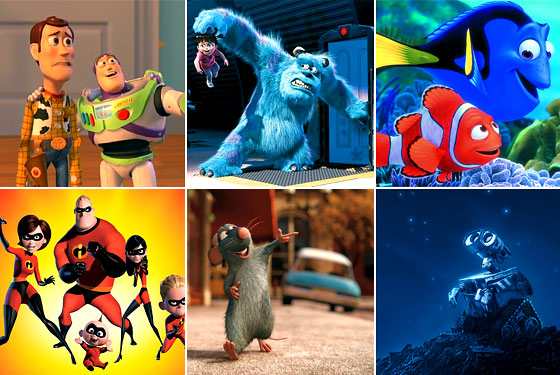
pixar saves our youth from existential meltdown


my childhood relationship with film consists mainly of memories of disney animated films, with some star wars, batman, and wizard of oz mixed in, but for the most part, its safe to say most young adults these days are working off a youth filled with disney princesses, songs of love to come, and princes saving the rescue.
I know, its been said a million times over how problematic the fiction revolving around valiant princes and damsels in distress can be.


(If you aren't familiar- these stories promote the image of the helpless, thin, attractive, young woman who can do nothing but wait for a man to save her and close the drama of her existence with a kiss and marriage; meanwhile, men are given the sporty, heroic, strapping, young, handsome man whose sole purpose in life is to rule other people and save women who can't help themselves.... of course, its more complicated than this, but i digress)


BUT with the opening of WALL-E this past weekend and all the talk of PIXAR flooding the media, it dawned on me that perhaps one of the reasons this company is so great for children (and adults) today is their offering of animated films that focus our attention on issues perhaps more urgent, more age-appropriate (?), or dare I say, less psyche-damaging than the constant barrage of love stories and fantasies that have historically worked along side romantic comedies for ages, pushing the idea that a woman's troubles are all solved by a man and a marriage.
So, in this brief entry, I just want to say thank you to PIXAR for kicking Disney's ass.


This, of course, is not to say that I love some Little Mermaid from time to time.

Monday, May 26, 2008

can't non-European ancient civilizations just be smart without the help of aliens?!


so. the fourth installment of indiana jones. The Kingdom of the Crystal Skull (aka- an amalgam of ancient meso and south american civilazations that us Americans don't care to be accurate about!) communist russians, led by cate blanchett, who of course does a good job, but is nonetheless in an awkward role. its ridiculous that indy can't possibly fight just some random assholes, the films always have some political undertone thats never explored. and whats more, the political tension between the states and the soviet union isn't enough any more. Spielberg and Lucas needed to add the Maya, the Inca, and others to the list of misconstrued and poorly explored socio-historical foundations to their film.
The film follows Indy, his illegitimate son, and his ex-girlfriend on a fight contre the russians for the crystal skulls of the maya in peru, the land of the inca. while the story is a bit ridiculous and the film doesn't compare to the originals, it was still a fun summer film to see. until...
Aliens HAD to be involved. Its bad enough that Spielberg and Lucas couldn't allow this mystery civilization (Maya/Inca/Teotihuacan) credit for being amazingly culturally and technologically advanced for their time. instead, aliens taught them everything, giving them a leg up to other ancient civilizations. But beyond this, the end had to be one big CGI effect of cheesiness when the aliens leave in their spaceship.

While I appreciate the amazing technological advancements of CGI and what it has allowed films to become, Spielberg and Lucas take it too far. With all their funds and creativity of ole, their films could be much more fun and less ridiculous with some good old fashioned anamatronics and hand-crafted props. then, perhaps the stories wouldn't end with cop-outs like flying alien spaceships.

all in all, its a fun, mindless summer film, but its taints the name of indiana jones. i will admit, if they make another indy flick, ill probably go, but ill go to matinee showing after its been in theaters awhile. Just like you all should do with this one.

Wednesday, April 9, 2008

NY cream, Southern dreams...

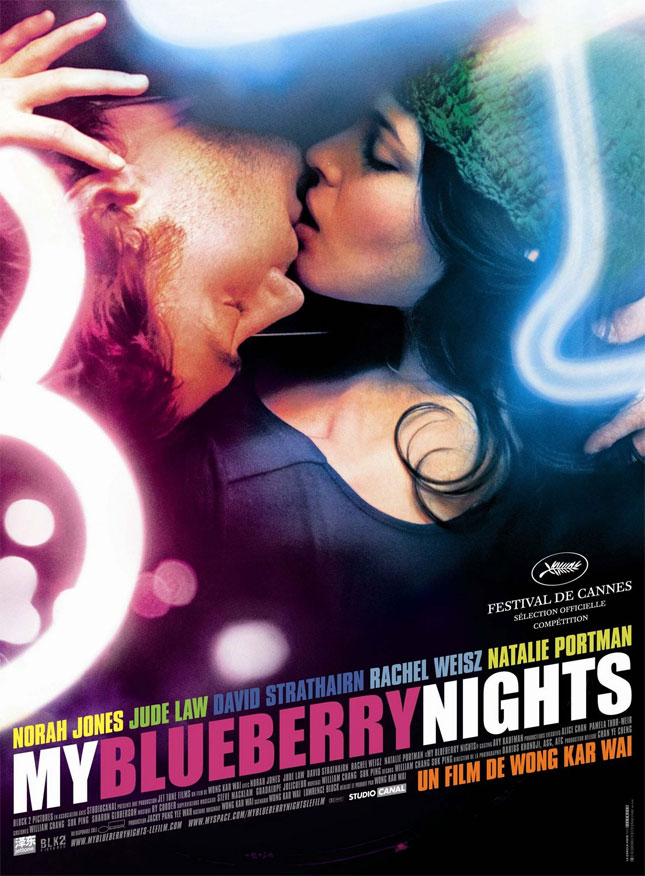
Wong Kar Wai's new film, My Blueberry Nights, deserves much more credit than most critics seem to give. I agree the shots through the glass were a little excessive, and the narrative is not the most interesting and complex plot, but if you like his previous work, this film is definitely worth a peek.

It follows Norah Jones, an interesting choice, as her character, Elizabeth, travels the states to get over a man. In very Wong Kar Wai fashion, the narrative is broken into multiple smaller narratives, New York/Nashville/Vegas. There was not enough of the frame-narrative in New York if you ask me, but perhaps its my hopelessly romantic side wanting Jude Law to kiss the "cream" off Norah Jones' face over a countertop just one more time.

Yes, "cream," as it is narratively ice cream, but bodily cream is a valid alternative. Perhaps the semen reference is going too far, but the repeated extreme close up of the melted ice cream flowing over blueberry pie juxtaposed with their sexual tension begs for such an interpretation.

But alas, the pie doesn't continue much visually throughout the other narratives. Elizabeth as waitress and evolving-woman are what do remain constant, although her growth is not very noticeable until she bluntly discusses it at the end of the film. Her innocence, rather, still punctures all of her scenes, and hinders her "growth through experience" that seems to be the point of her story.

If you're anything like me though, the narrative is not necessarily the main reason you go to a Wong Kar Wai film. The first appeal, rather, is the visual techniques and manipulation of time and space. And this is abundant, dare I say overly so... if there is such a thing in one of his films.
For me the biggest adjustment though, and perhaps hurdle, to viewing the film was the absence of subtitles. My experience with his films has always included the translation through subtitles and the separation from the narrative inherently attached to the reading of dialogue. His other films are more stimulating thematically, narratively, and visually, but I wonder if it is this ability to immerse oneself in the narrative more easily than his other work, that drove me to see faults much more quickly or make them appear worse than they otherwise would have. Also, of his work, this is the first I have seen which focuses on women. Combined with the foreign environment of the United States, the film seems to be more a first draft of what he is capable.

I commend him for testing the waters of English-language cinema, female protagonists, and U.S. environments, and while I think the helpless romantic and lovelorn male characters work much better for him , along with the globalization undercurrent depicted through the environment of Hong Kong and his usage of numerous languages, My Blueberry Nights is a decent attempt to go beyond this repertoire, and maybe his next try will be more appealing to the non-die hard Kar Wai fans.

Monday, April 7, 2008

Goudal's Hallucinations, Discuss!

Welcome to my debut! Or as they pronounce it on Degrassi, my day-boo!

The French film theorist Jean Goudal once referenced images in cinema to conscious hallucinations. I couldn't help but gravitate toward this phrase, as I do many quotations and thoughts within writing. This time, I must say, it was refreshing to hear someone describe cinema in a context other than the picture versus window scenario, as useful as that may be. This description hints at both the frame and the window, both fiction and reality, both the conscious and subconscious, which says much more than a simple dichotomy could ever imagine.

With this phrase as my jumping off point, I hope to investigate films and various media with a multifaceted perspective. Through my interests in identity politics and cultural studies along with film theory, history, and criticism, this blog aims to be more than simple movie reviews, but rather an analysis of the art form and its cultural and ideological significances. Enjoy!

"Neither a pea, nor a nut":
My Blueberry Nights
Killer of Sheep
Wristcutters: A Love Story